HUD Awards $15 Million to Address Unsheltered Homelessness
The Alameda County Continuum of Care (CoC) was awarded $15 million over the next 3 years to support 5 new projects focused on serving people who are unhoused and living in encampments, outside, and in their vehicles. Alameda County’s CoC is one of only two CoCs in California to receive such an award.
According to the 2022 Point in Time Count, over 7,000 people are experiencing unsheltered homelessness in Alameda County. This critical funding will support our community’s ability to respond to this humanitarian crisis. A summary of the recommendations for funding priorities from the committee and workgroup of people with lived experience who contributed their experience to this Plan can be found here.
New projects that this funding award will support:
- Enhanced Care Vouchers (Office of Homeless Care and Coordination): This project will create 100 new permanent supportive housing units and provide enhanced care for people with chronic medical and mental health conditions.
- Navigate to Housing (City of Oakland): This new rapid rehousing project will provide rental assistance, case management, and housing search assistance with a focus on serving people living in encampments in Oakland.
- Housing Advocacy for Unsheltered Homelessness Seniors (Homeless Action Center-new to CoC funding): This program will offer trauma-informed advocacy and legal services for unsheltered seniors to increase their income and address barriers to housing.
- Neighbor to Neighbor Street Outreach (St. Mary's Center): This project will train specialized peer Outreach Ambassadors who will provide outreach and navigation services to seniors living in encampments, especially in West Oakland.
- Mobile Action Points (Office of Homeless Care and Coordination): This project will create new mobile access points into the Coordinated Entry system that will operate across five geographic zones to meet people where they are living and connect them quickly to resources.
Home Together 2026
The Home Together 2026 Community Plan lays out the goals, strategies and investments needed to dramatically reduce homelessness in Alameda County by 2026 and combat racial disparities in homelessness by fully centering equity.
The Plan was released in May of 2022 and adopted by the Alameda County Board of Supervisors, the Oakland, Berkeley/Alameda County Continuum of Care and mayors and city councils throughout the county.
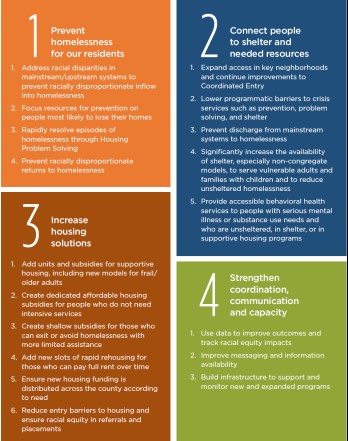
The Home Together 2026 Community Plan recommends specific action steps in four categories:
|
 |
 |
The Home Together Year 2 Progress Update describes progress towards the Home Together 2026 goals during the second year of the Plan.
Community Care Expansion
Two Alameda County projects were recently awarded $41 million through California’s Community Care Expansion (CCE) program to create 300 permanent, affordable housing units and supportive services to seniors and adults with disabilities and complex health conditions. CCE is a bold statewide initiative launched by the California Department of Social Services to improve the safety and quality of life of low-income seniors and adults with disabilities by preserving existing licensed residential adult and senior care facilities serving people currently experiencing, or at risk of homelessness.
Alameda County’s CCE-awarded projects will preserve and operate:
- St. Regis Community Care Campus, an existing 158-room, 194-bed multi-building facility in Hayward that supports senior independent living, assisted living and memory care. The project will be operated by Bay Area Community Services (BACS).
- The Alameda Wellness Campus, an existing 100-unit senior permanent supportive housing integrated with healthcare, medical respite and services for unhoused seniors and adults with complex health conditions. The site will also include a Respite Center and Health Clinic that provides 50 medical respite beds for unhoused adults with acute health conditions or in need of hospice and a health clinic providing medical, behavioral health, and palliative care. The project will be managed by Alameda Point Collaborative (APC) and represents a partnership with Lifelong Medical Care (service provider) and Mercy Housing (housing developer).
Alameda County’s Behavioral Health Care Services Department was also awarded $18 million this year to add 69 treatment beds at three sites in the county, expanding capacity to serve people with mental illness and/or substance use disorders in under-resourced communities.

Measure A1
The Measure A1 Affordable Housing General Obligation Bond program was approved by over 70% of voters in November 2016 and is being used to provide up to $580 million for the creation and protection of affordable housing options for Alameda County residents who need it most. Measure A1 provides significant new opportunities to assist renters, new homeowners, and those at risk of losing their homes. As of February 2019, $245 million in Measure A1 commitment had leveraged over $1.5 billion to support over 2,400 new affordable units in Alameda County
Additional information about Measure A1 can be via Alameda County’s Community Development Agency.
Homeless Housing, Assistance and Prevention (HHAP) Grant Program
The Homeless Housing, Assistance and Prevention Program (HHAP) is a block grant program designed to support regional coordination and expand or develop local capacity to end and prevent homelessness in local communities throughout the state of California. Funds are focused on moving homeless individuals and families into permanent housing and ensuring those individuals and families maintain their permanent housing. Read more about HHAP Rounds 1-5.
No Place Like Home
In 2018 California voters passed No Place Like Home, a $2 billion statewide bond program operated by California Housing and Community Development to create more supportive housing units throughout the state for homeless individuals and families struggling with a serious mental illness.
Community Health Record
The Alameda County Community Health Record (CHR) is an electronic record application that will summarize curated information from different organizations involved in consumer care. Qualified care coordinators and physicians will be able to access curated consumer information from multiple providers to coordinate care across organizations and have the ability to leverage consumer information to deliver the right care, at the right time, in the right place. Information from multiple providers including: physical health (inpatient, emergency departments, outpatient, primary care), mental health, housing resource centers, and social services can be used to coordinate care across organizations. Consumers will receive more efficient and effective care by allowing providers to share information that improves outcomes and accelerates the delivery of services.
For questions, please email CareConnectHelp@acgov.org or call 510-618-1997